FREE RESOURCE FOR WRITERS
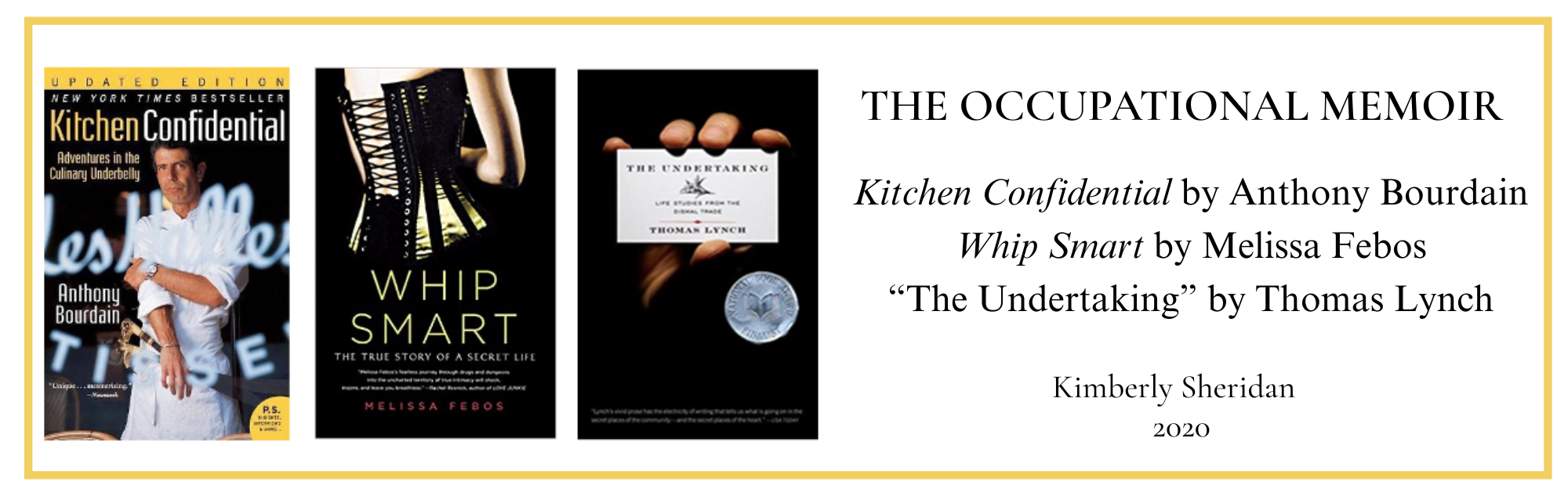
This was my 10-minute craft lecture for my 2020 thesis defense on one of my favorite forms of nonfiction writing: the occupational memoir.
I’m looking at how insiders write about their industries, not reporters who observe and witness from a distance—although that has its own benefits and merits. Insiders are both participants and observers, with an intimate knowledge of the subcultures, a stake in the work, and identities forged by the worlds they inhabit. In his preface to Kitchen Confidential, Chef Anthony Bourdain writes, “I’m asked a lot what the best thing about cooking for a living is. And it’s this: to be a part of a subculture. To be part of a historical continuum, a secret society with its own language and customs.”
These writers prove on the page that a deep dive into an industry can unearth pride, grit, shame, class, addiction, culture, love, pleasure, power, rebellion, and death: In other words, all of humanity in its beauty, hilarity, and terror. In the words of Montaigne, “I am Human, let nothing human be foreign to me.” This is also the epigraph in Whip Smart.
So which craft techniques and tools do authors use to bring the reader into the depths of a culinary underbelly, a secret life, a dismal trade, an occupation?
✦
I’ll start with the first step through the door—the first line of the book or essay. These strong first lines do a lot of work and set up what’s to come.
The first line of “The Undertaking”:
“Every year I bury a couple hundred of my townspeople.”
Lynch starts his essay with a short, declarative, straightforward punch. It catches our attention, and we also know he’s probably in a smaller community because of the use of the word “townspeople.”
The first line of Whip Smart:
“Steve knew to be kneeling when I walked into the Red Room, his torso bent over his knees, forehead resting on the rug.”
Febos starts in action, in a scene, in the dungeon. Starting in scene is common in all types of nonfiction and literature, but this works especially well with taboo and voyeuristic material; we get a peek into the red room, and what usually goes unseen, right off the bat.
The first line of Kitchen Confidential:
“My first indication that food was something other than a substance one stuffed in one’s face when hungry—like filling up at a gas station—came after fourth grade in elementary school.”
Bourdain starts his book with childhood memories and where it all began. It’s a lead-in to Why food?
Where does a lifelong obsession begin? What does it represent?
✦
Another important tool is sharing details and processes and educating the reader. Inside an industry, it can be easy to assume others know what you know, take it for granted, or figure that the small details don’t matter, but they do. These details can include tools of the trade, uniforms, cost of services, and jargon.
An example from Kitchen Confidential: “You need, for God’s sake, a decent chef’s knife. No con foisted on the general public is so atrocious, so wrong-headed or so widely believed as the one that tells you you need a full set of specialized cutlery in various sizes.” (76)
Here, Bourdain is speaking directly to the reader; he’s educating us and letting us in on industry knowledge and expertise. We feel smarter and more informed having read it.
And an example from “The Undertaking”: “I used to use the unit pricing method—the old package deal. It meant that you had only one number to look at. It was a large number. Now everything is itemized. It’s the law. So now there is a long list of items and numbers and italicized disclaimers, something like a menu or the Sears Roebuck Wish Book, and sometimes the federally mandated options begin to look like cruise control or rear-window defrost. I wear black most of the time, to keep folks in mind of the fact we’re not talking Buicks here. At the bottom of the list there is still a large number.”
In this section of the essay, Lynch breaks down the nuts and bolts of his business and also exposes some of the absurdity and dark humor in it. Burying someone isn’t cheap, but it’s still a business.
✦
One of my favorite techniques is finding the profound in the common or mundane–and its opposite–finding the mundanity in the extreme or shocking. The tension between the two is compelling and lets the reader see something in a new or unexpected light.
First, we’ll look at some examples of the mundane in the extreme . . .
Febos writes about being a dominatrix, “The day-shift crowd scheduled their whippings the way they scheduled business luncheons: out of necessity and convenience. En route to the dungeon they dropped off the dry cleaning, or their wives at Macy’s. Just as the cafes all over midtown Manhattan had their lunch rushes, so did we.” (8)
And after a client of hers leaves, she notes, “Before I even heard the click of the door’s lock, I pulled my hair into a bun, kicked off my heels, and headed back to clean the Red Room. I had an exam the next morning to study for.” (8)
This approach normalizes the clients and breaks down notions about them just being weird social outcasts. Her moments of matter-of-factness about her job remind the reader that she has a whole other life outside of her fantasy persona, “Justine.”
It’s also more interesting. People are nuanced and complicated, and if they were unable to be humanized, we wouldn’t be able to relate to or care about them.
Also finding the mundane in the shocking, here is Lynch’s take on people dying:
"They die around the clock here, without apparent preference for a day of the week, month of the year; there is no clear favorite in the way of season. Nor does the alignment of the stars, fullness of moon, or liturgical calendar have very much to do with it. Their whereabouts are neither here nor there…no cause of death is any less permanent than the other. Anyone will do. The dead don’t care.” (5)
Lynch repeats “the dead don’t care” throughout his essay. This also seems like a matter-of-fact or unemotional way of looking at a fraught and intense event, but he’s a cool observer, and he witnesses death every day–and the insight gleaned is that the living care, but the dead do not. (I should note that this is one approach of many that's utilized in a text because if no compassion came through in the essay, it could seem cold or very one-note.)
Now for the opposite—an example of finding excitement in the daily or the mundane:
Bourdain writes, “The goads, curses, insults and taunts of my wildly profane crew are like poetry to me, beautiful at times, each tiny variation on a classic theme like some Beat-era jazz riff: Coltrane doing “My Favorite Things” over and over again, but making it new and different each time. There are, it turns out, a million ways to say “suck my dick.” Most of the people in my kitchen can do it in Spanish, French, Italian, Arabic, Bengali and English. Like all great performances, it’s about timing, tone and delivery—kind of like cooking.” (222)
Bourdain revels in cook-talk and gives many examples throughout the book of the insults and language thrown around in a kitchen. It’s a relatively small observation that really tells us about the everyday routine and a lot about the people in the kitchen. It’s hilarious and delightful, and, if you’ve ever worked in food, very true.
✦
The last techniques I’ll cover are The Big We and Self-Implication.
The first is speaking as a “representative” of the industry: we cooks are this, we undertakers do that. The writer becomes the face of the occupation. The second technique, self-implication, is a nice balance to being the representative. If you’re going to expose or make judgments on an entire industry, you have to be honest and vulnerable and implicate yourself in the process as well.
An example of Febos representing the We, the Industry:
“Both my clients and my coworkers were designing their own humiliation. Freud said that there is no sadism without masochism. I can vouch for that in my dungeon. If any of us were sadists, we were the masochistic kind. And if there ever was a sadistic masochist in New York City, he undoubtedly crossed the doorway of Mistress X’s…Those clients who preyed on new hires were looking for victims, not masters. I met many men whose real pleasure seemed found in demanding torture methods more humiliating for their domme than for them. It was their fantasy, after all.” (149)
In this section, Febos uses the We to speak about the disempowerment she starts to see in the whole subculture; she’s exposing the humiliation of both the dommes and the clients, and she’s critiquing the industry as an insider who’s been up close with all of it.
And an example of her self-implicating:
“I didn’t end up at the dungeon out of financial desperation, nor anthropological curiosity. I was not a tourist but a member of that world, with reasons for being there similar to those of everyone else: an obsession with power, having it and having it taken away from me. These existed long before I ever walked into the dungeon. My experiences at the dungeon were a result of my own desire and pathology, not the other way around.” (257)
Here, Febos confesses she’s not separate from that world; she’s a part of it. By self-implicating, she acknowledges her role, her choices, and her participation. Self-implication is a tool that’s also useful for acknowledging that one person can never be a complete representative for an entire industry. Another dominatrix may have a totally different take on the experience, but this book is through Febos’s lens—her psychology, inner workings, and observations.
Moving on to Kitchen Confidential, here’s Bourdain representing The Big We:
“If the chef is anything like me, the cooks are a dysfunctional, mercenary lot, fringe-dwellers motivated by money, the peculiar lifestyle of cooking and grim pride. They’re probably not even American…The job requires character—and endurance. A good line cook never shows up late, never calls in sick and works through pain and injury.” (55)
Bourdain uses the proud We often. He sees himself as one of these gritty cooks he admires; he is a dysfunctional, profane character like the rest of them, but he’s also white and well-trained. In parts of his career, he’s the one called on by the restaurant owners to ruthlessly cut and fire people.
Here’s Bourdain using self-implication:
“But the Mexicans and Ecuadorians and Salvadorians and Latinos, who’d look at me with moist eyes as they realized that there’d be no check next week or the week after—when they asked that terrible question, “Porque? Why, Chef? No work for me?” as if maybe they’d heard wrong—this was really grinding me down, tearing at what was left of my conscience.” (142)
Bourdain loves being a hardass. He expects hard work and loyalty, and he went to culinary school in part to get back at a kitchen staff who humiliated him when he was young. It was the “I’ll show them” mentality. But he’s our rebel with a heart of gold—Bourdain shows us that he cares, that he loves his industry, and that the loyalty he commands he’s also capable of giving.
✦
In conclusion, some of the techniques writers use in occupational memoirs and essays are strong first lines, details to educate the reader, finding the profound in the mundane and the mundane in the extreme, representing the industry or “the we,” and self-implicating. Because of these tools, and many others, the reader or outsider enters a new world and exits it with more knowledge about an occupation, humanity, and themselves.
Thomas Lynch is the undertaker, but in recognizing the meaning-making threads that run through all kinds of workers, he notes, “Which undertaking is it then that does not seek to make some sense of life and living, dying and the dead?”